
Review of the ASUS ROG Zephyrus G14 — the ultimate gaming laptop without compromises

Review of ASUS ROG Zephyrus G14 — the ultimate gaming laptop without compromises
The 14-inch ASUS flagship received an OLED display with HDR1000, RTX 5080, Intel Core Ultra 9, and impressive battery life, while remaining surprisingly compact and lightweight.
ROG Zephyrus machines try to squeeze desktop-class speed into small chassis; the 2026 G14 keeps that habit and dresses it up with Intel Core Ultra 300 silicon and RTX 50-series GPUs. This piece focuses on the flagship 14-inch configuration—what it brings, what it hides, and how it behaves under real use.
Unboxing and first impressions come quickly: the bundle is generous. You get the laptop, paperwork, two PSUs (a 100W USB-C and a 250W barrel-type), plus a carry sleeve. The sleeve isn’t required—metal chassis are tough—but I appreciated having it for transport.
Visually the G14 hasn’t deviated far from its predecessor. A flat metal lid carries a diagonal glossy strip that conceals the Slash Lighting array; now 35 individually controlled zones instead of the old 7. The bottom panel is metal and perforated for speakers and airflow. Audio hardware totals six drivers: two tweeters and four woofers.
Physically, it’s very portable: 31.1 x 22 x 1.59–1.83 cm and 1.58 kg. That size makes it easy to toss into a backpack and head out.
Port selection is practical. There’s HDMI 2.1, two USB-A 3.2 Gen 2 ports (10 Gb/s), a USB-C 3.2 Gen 2 with DP Alt Mode (10 Gb/s), Thunderbolt 4 (TB4), a 3.5 mm combo jack, and a UHS-II card reader. For extra I/O you can always plug into a TB dock.
Open the lid and you see the 14-inch OLED: 2880×1800 (16:10), 120 Hz, VESA DisplayHDR True Black 1000. Peak brightness hits about 1100 nits and Dolby Vision is supported. A MUX switch is included, so iGPU and dGPU can each be routed to the panel without unnecessary bottlenecks.
This OLED panel is among the best laptop displays I’ve used—deep blacks, instant pixel response and excellent color—though calling anything “perfect” would be premature since individual needs vary (color-work pros might still check calibration options).
A webcam sits above the screen and includes an IR sensor for Windows Hello.
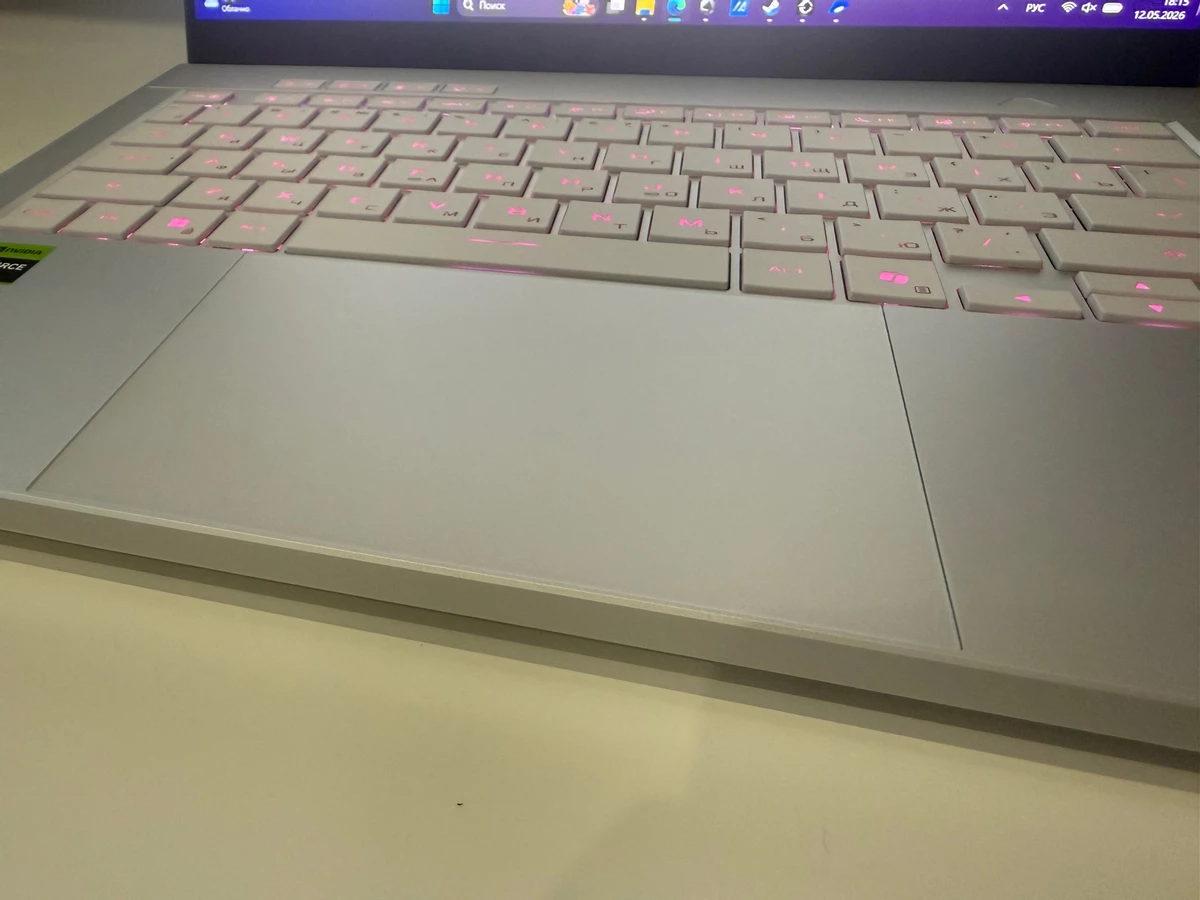
The keyboard uses a membrane mechanism and a compact layout with no numpad; that omission lets ASUS center the touchpad beneath the spacebar. Small arrow keys on the right are the one ergonomic gripe; they feel cramped until you adapt. There’s single-zone backlighting under the keys and, overall, typing is comfortable.
The touchpad itself is large, responsive and feels like it stretches almost to the edges of the chassis—little bezel above or below it—which makes gestures smooth and natural.
Moving on to the device’s performance, first we need to look at the technical specifications.
- Processor — Intel Core Ultra 9 386H.
- Graphics card — NVIDIA GeForce RTX 5080 for laptops.
- RAM — 32 GB LPDDR5X.
- SSD — 1 TB PCIe 4.0 x4.
Benchmarks start with synthetic workloads; gaming runs were done at 1200p and 1800p with DLSS engaged when appropriate. DLSS 4.5 delivers image quality that can match or even outdo native TAA in many scenes, and frame generation—especially dynamic multi-frame—gives a noticeable boost when enabled on the RTX 5080.
Performance is strong across the board. Still, raw numbers don’t tell the whole story: thermals and fan noise matter for a compact machine. I ran sustained stress tests and gaming sessions to check temperatures and acoustics; results show the G14 manages heat well for its size, but fans become audible under heavy sustained load.
Battery life is handled by a 73 Wh cell. In practice that translates to nearly a full day when looping 1080p video and north of 12 hours for light productivity and web browsing. Gaming pulls the battery down much faster: expect roughly 1.5 hours in heavy, discrete-GPU titles, and about 2.5–3 hours if you stick to lighter games using the iGPU.
Traditonally, to summarize
The Zephyrus G14 balances a compact footprint with very capable hardware. Highlights: an impressive OLED panel, a potent CPU/GPU combo (CPU = Core Ultra 9, GPU = RTX 5080), and decent battery life for non-gaming tasks. Trade-offs exist—price is high, small arrow keys are fiddly, and the fans get loud during extended heavy use—so it isn’t an unquestioned buy for everyone. If you want a genuinely portable machine that can still run modern games well and you can live with the cost and occasional fan noise, this G14 is a strong contender.