
Kingdom Come director defends DLSS 5 again - the technology makes characters look more like real actors

Kingdom Come Director Defends DLSS 5 Again – Technology Makes Characters Look More Like Real Actors
DLSS 5 remains controversial among players for the visual differences it introduces, but Daniel Vávra, creative director of the Kingdom Come: Deliverance series, has again defended the technology and argued that some of the criticism is exaggerated.
For context, see this guide: How to install DLSS 5 on any game and any graphics card – AMD Radeon and RTX 20, 30, 40 series
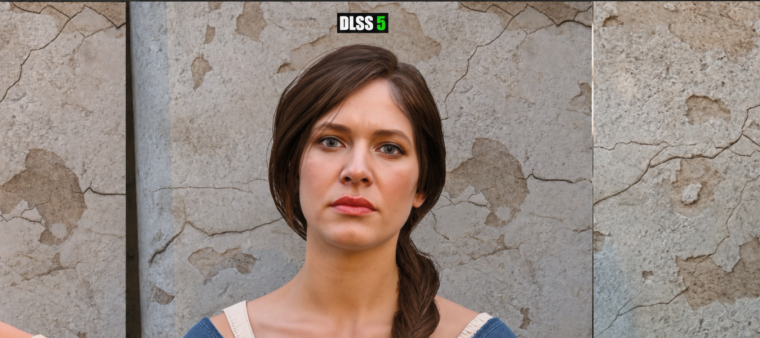
In a recent post on social media, Vávra published a four-image comparison featuring Katerina, a character from Kingdom Come: Deliverance II whose likeness was based on Czech actress Kristýna Leichtová. The panel shows: a real photograph of Leichtová, Katerina as she appears in the original game, the character rendered with what Vávra regards as the optimal DLSS 5 settings, and a version produced with DLSS 5 set to its most aggressive level — which he labels “slop.”
Vávra argues that the third image most faithfully represents the actress’s appearance in-game. He contends DLSS 5 makes facial and hair details — the nose, eyes, hair texture, subtle shadowing, and neck contours — appear more naturally, rather than inventing features. According to him, those details already exist in the game’s 3D model and textures; they are simply not always visible under the standard lighting provided by the engine. Vávra says DLSS 5 can use information such as normal maps to reveal these embedded cues, bringing the character closer to the real-life reference.
Developers Can Adjust This Effect
Vávra also pushed back against the idea that DLSS 5 forces a single, unavoidable look on developers. He suggested that, had the tool been available earlier, the team could have altered Katerina’s model — for example to make her look younger — while still applying DLSS 5’s lighting and shadow enhancements. In his view, the technology functions as an additional tool that developers can use or tune to retain creative control over a character’s appearance.
At the same time, Vávra acknowledges a potential downside: DLSS 5’s increased realism may risk pushing characters into the “uncanny valley,” producing an uneasy reaction similar to the discomfort some viewers feel from TV “motion smoothing” (commonly called the “soap opera effect”), where frame interpolation gives films an unnatural smoothness. He said developers will need to learn how to handle this level of fidelity, and noted that DLSS 5 is still in an early phase and will continue to evolve.
For now, Vávra considers the DLSS 5 result shown in the third image a visual improvement that more closely matches the lighting quality he originally intended for the game.