
Brazilian bloggers have dismantled the RTX 5090 to solve the problem of melting power connectors

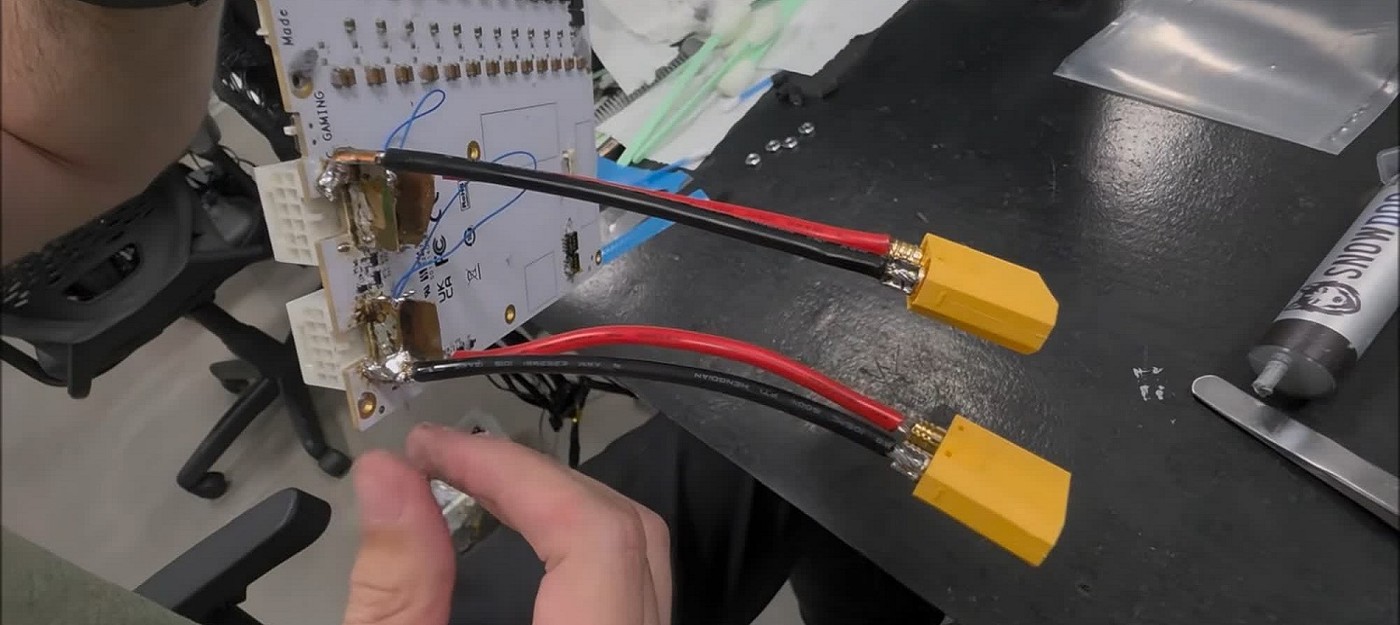
The problem of melting 16-pin power connectors on RTX 5090 and RTX 4090 cards has been dragging on for more than a year; Nvidia still hasn't offered a sweeping fix. In response, a Brazilian YouTube crew, TecLab, took a deliberately extreme — and sarcastic — route: ditch the connector entirely and solder the power wires straight to the graphics-card PCB.
Their test subject was a Galax GeForce RTX 5090 D HOF OC LAB XOC, an extreme OC edition that already ships w/ two 16-pin power plugs. The teardown and mod ran in two main phases. First: use two adapters to merge the cables from both connectors into two single bundles, then solder those bundles directly onto PCB traces — the stock connector removed from the power path. Second: strip off the original heatsink and a pair of 120 mm fans, then hook the card up to industrial water cooling to keep the die from roasting.
The video doesn’t publish exact GPU temps, but the measured current on the 12 V rail was roughly 50 A (i.e., about 600 W). That’s over the usual RTX 5090 production TDP of 575 W. For this specific Galax board, however, that wasn’t anywhere near the top end: thanks to a custom firmware aimed at pro overclockers, the card reportedly tolerates loads up to 2000 W.
TecLab stressed the obvious: this is not a how-to for ordinary gamers. Their clip functions more as a snarky commentary on Nvidia’s reluctance (or inability) to address a persistent hardware flaw than as an endorsement of brute-force hardware surgery on a ~$5,000 component.
Complaints about melting connectors started almost immediately after the RTX 5090 launched in Jan 2025. Reports popped up in Feb, two more in Apr, and another in May. DSO Gaming’s John Papadopoulos also documented a case: a 12V‑2x6 cable on his RTX 5090 melted during a gaming session of Wuchang: Fallen Feathers.